
Searle's Chinese Room but make it 'I understand AI better than AI researchers'
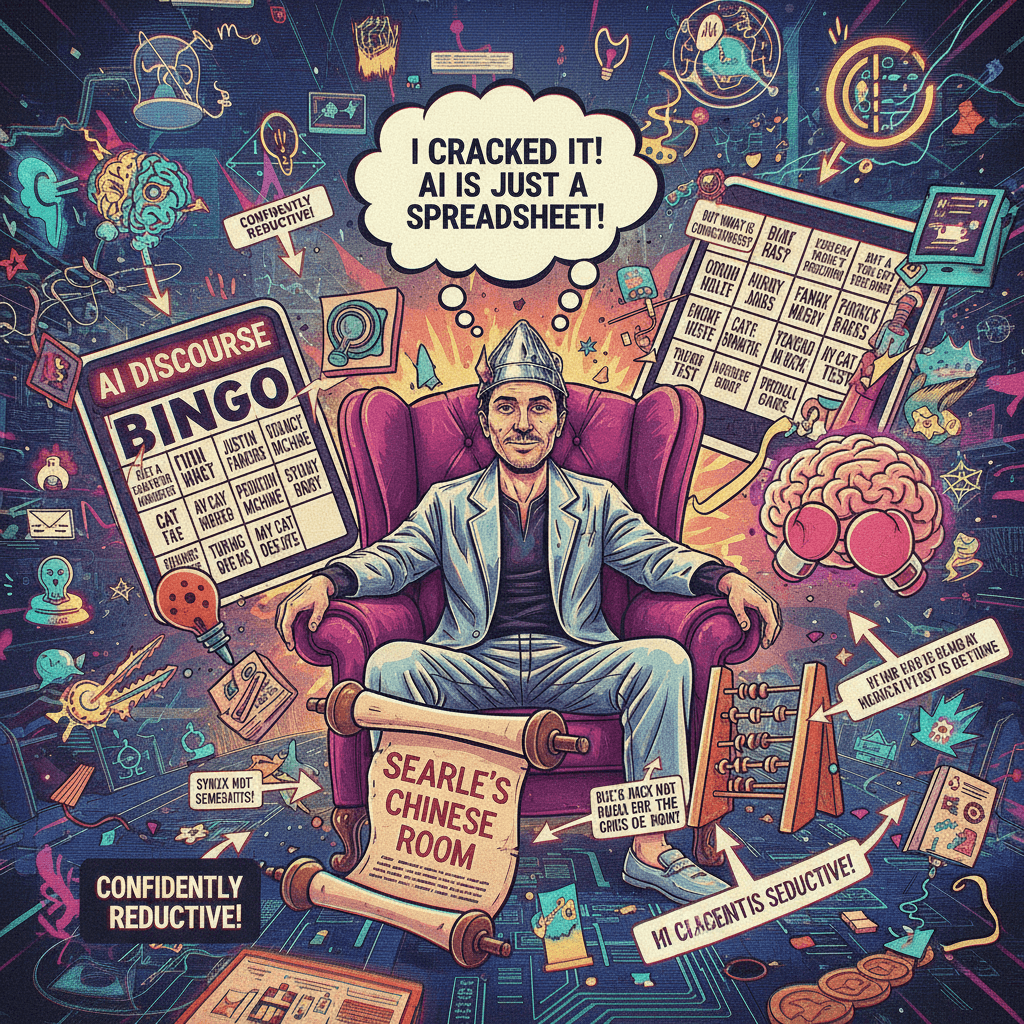
Alright, since you asked:
Imagine a room. Four walls, a floor, and a ceiling. No windows. There’s a slot in one of the walls. You’re inside the room, and your job is simple (if a bit laborious). Every day, people outside the room pass notes written in Chinese through the slot, and you respond to those notes.
Now, you don’t know a bit of Chinese, but you have a (VERY thick) rulebook that tells you exactly which Chinese symbols to pass back through the slot in response to the notes from outside. If you see symbol group A followed by B on a note, you look up the rule, which tells you to hand back symbols X, Y, and Z in response. You just shape-match, follow the rules, and pass back notes that mean absolutely nothing to you… because you still don’t know any Chinese.
The people outside the room never see you, and they think they’re communicating with someone in Chinese because you pass the Turing test with flying colors. You get REALLY good at using that rulebook.
That, folks, is John Searle’s Chinese Room thought experiment—and it’s also a description of Claude, Grok, Copilot, ChatGPT, etc.
Claude is not experiencing anxiety. It’s also not thinking or communicating in any way.